
The cardboard box arrives at your customer’s doorstep. In three seconds, they decide whether to feel excitement or indifference. That fleeting moment is packaging at work—silently shaping brand perception before the product is even revealed.
For businesses navigating today’s competitive landscape, the packaging choice between custom and standard options is far more than a logistics decision. It’s a strategic fork in the road that influences brand perception, customer loyalty, operational costs, and even environmental footprint.
This comprehensive guide breaks down everything you need to know about custom versus standard packaging, helping you determine which approach aligns with your business goals, budget, and brand vision.
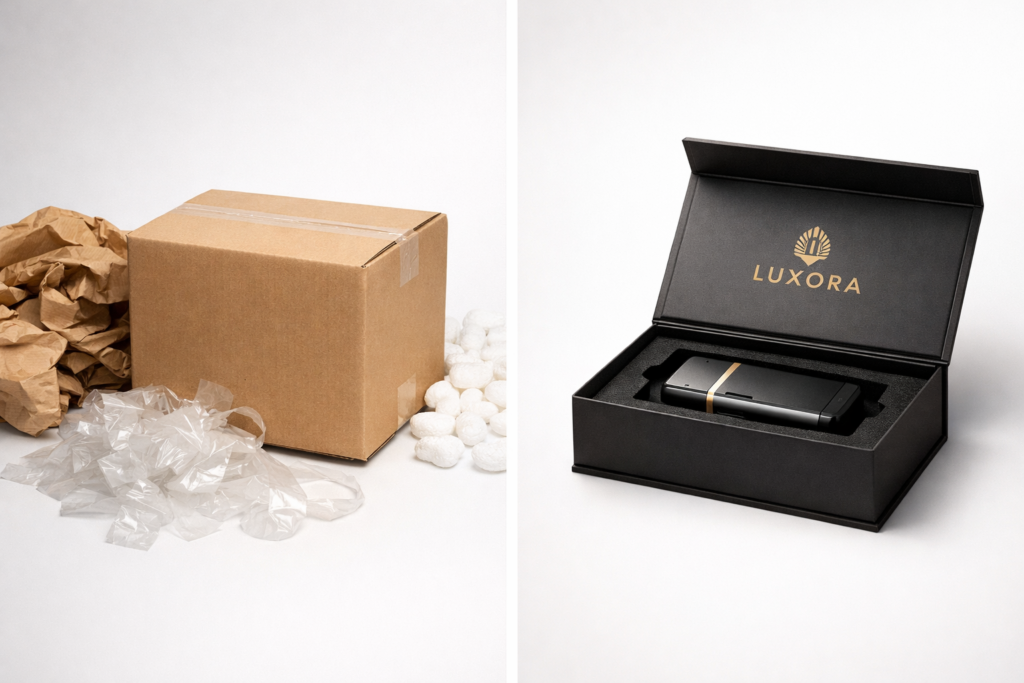
What Exactly Are Custom and Standard Packaging?
Before diving into the comparison, let’s clarify what these terms actually mean.
Standard packaging (also called generic or stock packaging) refers to pre-manufactured boxes, mailers, and containers produced in generic sizes and designs for broad use. These are plain, mass-produced options with no custom branding, logos, or unique design elements. Think of the unmarked brown corrugated boxes you receive from Amazon—functional, economical, but entirely forgettable.
Custom packaging, by contrast, is designed specifically for a product, brand, or audience. It can incorporate structural features, branded print, premium finishes, or regulatory labeling tailored to your exact specifications. From logo placement and custom colors to unique shapes and specialized inserts, custom packaging transforms a simple container into an extension of your brand identity.
The global custom packaging market reflects this growing importance. Valued at $48.17 billion in 2025, it’s projected to reach $81.04 billion by 2034, growing at a CAGR of 6.06%. The personalized packaging segment for D2C brands is growing even faster at 11.5% annually, expected to hit $14.3 billion by 2032.
Custom vs Standard Packaging: Side-by-Side Comparison
| Factor | Standard Packaging | Custom Packaging |
|---|---|---|
| Upfront Cost | Low to moderate | Moderate to high |
| Per-Unit Cost (Volume) | Low, decreases with scale | Low, decreases with scale; may approach standard at high volumes |
| Lead Time | Immediate to 1-2 weeks | 4-8 weeks (design + production) |
| Brand Visibility | None (plain/unbranded) | High (logo, colors, finishes) |
| Product Protection | Generic fit, may require void fill | Perfect fit, reduced movement |
| Unboxing Experience | Minimal to none | Premium, memorable, shareable |
| Customer Perception | Functional, budget-oriented | Quality, thoughtful, premium |
| Sustainability Potential | May over-pack, more waste | Right-sized, reduced void fill |
| Return Rate Impact | Baseline | 8-12% reduction possible |
| Social Media Shareability | Low | High (unboxing videos, photos) |
Standard Packaging: The Case for Keeping It Simple
Standard packaging shines in specific scenarios. Here’s when it makes strategic sense.
Advantages of Standard Packaging
1. Lower Upfront Costs — Standard packaging involves no design fees, no printing plates, and no minimum order quantities for custom tooling. You simply purchase what you need from existing inventory. This makes it particularly attractive for startups testing products or businesses with tight cash flow.
2. Faster Sourcing and Implementation — Need boxes tomorrow? Standard packaging is readily available from countless suppliers. There’s no design approval process, no sampling phase, and no waiting for custom production runs.
3. Ideal for High-Volume, Low-Margin Products — When your product is purely functional (hardware, bulk components, industrial supplies) and customers prioritize price over presentation, standard packaging gets the job done efficiently.
4. Works Well for Short-Term Campaigns — Running a limited-time promotion or seasonal offer? Standard packaging avoids locking you into custom inventory that may become obsolete.
Drawbacks of Standard Packaging
1. Zero Brand Differentiation — In a crowded marketplace, standard packaging makes your product indistinguishable from competitors. You’re essentially forfeiting a prime branding opportunity.
2. Missed Unboxing Moment — Generic packaging communicates apathy rather than quality. It’s a missed opportunity to create an emotional connection with customers at the moment of truth.
3. Potential for Inefficient Fit — Standard sizes rarely match product dimensions perfectly, leading to excessive void fill, wasted space, higher shipping costs, and increased material waste.
Custom Packaging: The Strategic Investment
Custom packaging has evolved from a luxury to a competitive necessity. Here’s why.
Advantages of Custom Packaging
1. Brand Recognition That Travels — Custom-printed packaging functions as a mobile billboard. Every delivery, every transit route, every social media post generates brand impressions. Custom paper bags in retail settings can lift brand recognition by up to 30% in high-traffic areas.
2. Elevated Perceived Value — Fifty-three percent of consumers link high-quality packaging with better product quality. That perception allows you to defend premium pricing, protect margins, and reduce reliance on expensive ad spend.
3. Superior Product Protection — Custom packaging can be right-sized to your product’s exact dimensions, minimizing movement during transit and reducing the need for void fill. This often leads to fewer damaged goods and lower return rates.
4. Memorable Unboxing Experience — Nearly half (47%) of consumers say premium packaging makes them more excited about opening a package. That excitement translates into social shares—over 78% of holiday shoppers shared at least one unboxing experience on social media. With over 92 million unboxing videos on YouTube, the marketing potential is enormous.
5. Improved Customer Retention — Optimized unboxing experiences can lift 90-day repeat purchase rates by 6–14% and reduce first-order return risk by 8–12%. Seventy-two percent of consumers will increase their willingness to repurchase due to a high-quality unboxing experience.
6. Sustainability Through Right-Sizing — Custom packaging reduces material waste by eliminating unnecessary void fill. Some manufacturers report that bespoke packaging can yield long-term savings by reducing damage, returns, and waste.
Drawbacks of Custom Packaging
1. Higher Initial Investment — Custom packaging requires design work, tooling (printing plates or molds), and often higher minimum order quantities. These upfront costs can be prohibitive for very small businesses or single SKUs.
2. Longer Lead Times — From design approval to production and delivery, custom packaging typically takes 4–8 weeks. This can be challenging for businesses with urgent launch timelines.
3. Inventory Commitment — Custom packaging requires ordering in quantities that may exceed immediate needs, tying up capital and storage space.
The ROI Question: Does Custom Packaging Pay for Itself?
The data suggests yes—but the payback period varies by business model.
For small businesses, custom packaging can deliver returns within six months. A 2025 survey found that 85% of small businesses saw ROI within six months of switching to custom packaging.
The math works like this: For a brand doing $1M annually with 10,000 orders, upgrading packaging might cost an additional $3,000–$7,500 per year. If custom packaging lifts repeat purchase rates by just 6%, that incremental revenue can quickly offset the cost. When combined with reduced return rates (8–12%) and increased brand recognition (up to 30%), the investment becomes increasingly compelling.
The break-even threshold for custom packaging typically comes when repeat purchase rate matters more than first-order customer acquisition cost. For established brands with loyal customer bases, the ROI is substantial.
Sustainability: A Complex Comparison
The sustainability debate between custom and standard packaging isn’t straightforward.
Standard packaging’s environmental case relies on efficiency: mass-produced boxes use standardized material sizes, potentially reducing manufacturing waste. However, the mismatch between box size and product size often leads to excessive void fill—extra material that serves no purpose and increases shipping emissions.
Custom packaging’s environmental case centers on right-sizing. By matching packaging precisely to product dimensions, custom solutions reduce void fill, eliminate unnecessary materials, and can lower shipping weight and volume. Some custom packaging manufacturers report material consumption reductions of 30% or more through optimized sizing.
Consumer preferences increasingly favor sustainable options. A 2025 McKinsey study found that younger consumers—particularly Gen Z and millennials—are most willing to pay a premium for sustainable packaging. Fifty-five percent of consumers say it’s extremely or very important that products come in sustainable packaging.
For businesses committed to sustainability, custom packaging offers the flexibility to choose eco-friendly materials, incorporate recycled content, and design for recyclability from the outset.
The Hybrid Approach: When Both Make Sense
Smart businesses don’t always choose one or the other. A hybrid strategy often works best:
- Standard outer boxes for cost-effective shipping, combined with custom inner packaging (tissue paper, stickers, inserts) that creates the unboxing moment without full-box customization.
- Custom packaging for hero products or premium lines, while using standard packaging for accessories, samples, or budget offerings.
- Gradual transition starting with custom stickers or branded tape on standard boxes, then moving to fully custom boxes as volume and budget grow.
EVA Packaging Inserts: The Tengyue Gift Solution
For businesses seeking the protection and presentation benefits of custom packaging without the complexity of full-box redesign, custom EVA foam inserts offer an elegant solution.
EVA (ethylene-vinyl acetate) foam inserts are precision-cut to cradle your product perfectly, providing:
- Superior shock absorption that reduces damage during transit
- A premium unboxing presentation that elevates perceived value
- Right-sized fit that eliminates wasteful void fill
- Customizable colors and branding that extend your visual identity into the package interior
At Shenzhen Tengyue Gift Co., Ltd. , we specialize in manufacturing high-quality EVA foam inserts tailored to your exact product specifications. Whether you need protective inserts for electronics, elegant cradles for luxury gifts, or custom-cut foam for subscription boxes, our expertise ensures your product arrives safely and impresses upon opening.
Unlike full-box customization that may require significant minimum orders, EVA inserts offer flexibility for businesses of all sizes. They can be produced in lower quantities, allowing you to test custom packaging benefits without major upfront commitment.
Ready to elevate your unboxing experience? Visit tengyuegift to explore our EVA custom packaging solutions.
How to Decide: A Decision Framework
Ask yourself these five questions to determine the right packaging strategy for your business:
| Question | If YES → Lean Custom | If NO → Standard May Suffice |
|---|---|---|
| Does packaging directly influence your customer’s purchase decision? | Yes | No |
| Are your products fragile or high-value? | Yes | No |
| Do you have an established customer base with repeat purchases? | Yes | No |
| Is brand differentiation a priority in your competitive market? | Yes | No |
| Can you absorb higher upfront costs for long-term gains? | Yes | No |
Generally speaking:
- Startups with limited cash → Start with standard + branded stickers/tape
- Established D2C brands → Custom packaging drives retention and referrals
- Luxury or premium products → Custom packaging is non-negotiable
- Commodity or B2B industrial → Standard packaging often sufficient
- Eco-focused brands → Custom right-sized packaging reduces waste
Frequently Asked Questions (FAQs)
1. Is custom packaging worth the extra cost for small businesses?
Yes, for many small businesses. A 2025 survey found that 85% of small businesses saw ROI from custom packaging within six months. The key is starting with lower-cost custom elements (stickers, inserts, branded tape) before committing to full-box customization.
2. How much more does custom packaging cost than standard?
For a business with 10,000 annual orders, upgrading from standard to custom packaging typically costs an additional $3,000–$7,500 per year, or $0.30–$0.75 per unit. Costs decrease significantly at higher volumes.
3. Can custom packaging help reduce shipping costs?
Yes. Right-sized custom packaging eliminates void fill and reduces dimensional weight, often lowering shipping costs. Some manufacturers report shipping cost reductions of 18% through optimized packaging.
4. How long does custom packaging take to produce?
Lead times typically range from 4–8 weeks from design approval to delivery, depending on complexity and quantity. Rush options may be available from some suppliers.
5. Is custom packaging more sustainable than standard?
Not automatically, but it can be. Custom packaging allows for right-sizing (reducing material waste) and material selection (recycled content, biodegradable options). Standard packaging often uses excess void fill. The most sustainable option depends on execution.
6. What’s the minimum order quantity for custom packaging?
MOQs vary widely by supplier and product type. Simple custom boxes may have MOQs of 500–1,000 units; complex rigid boxes may require 5,000+ units. EVA foam inserts often offer lower MOQs, making them accessible to smaller businesses.
7. Does custom packaging really impact customer loyalty?
Yes. Data shows optimized unboxing can lift 90-day repeat purchase rates by 6–14% and reduce first-order return risk by 8–12%. When customers feel delighted by the unboxing, they’re more likely to return.
8. Can I use custom packaging if I sell on Amazon or other marketplaces?
Yes, with considerations. Amazon’s frustration-free packaging program has specific requirements. For other marketplaces, custom packaging can be a powerful differentiator, but ensure compliance with any platform-specific guidelines.
9. How do I get started with custom packaging?
Start by requesting samples from manufacturers. Define your must-haves (logo placement, colors, materials) versus nice-to-haves. Begin with a small pilot run to test quality and customer response before scaling.
10. What’s the difference between custom boxes and custom inserts?
Custom boxes are the full container—printed, shaped, and constructed to your specifications. Custom inserts (like EVA foam) fit inside standard or custom boxes to cradle and protect products. Inserts offer a lower-cost entry point to custom packaging benefits.
Conclusion
The choice between custom and standard packaging isn’t about which is universally “better”—it’s about which aligns with your business stage, budget, and brand goals.
Standard packaging wins on speed and upfront cost. It’s the practical choice for testing products, managing tight margins, or serving markets where packaging simply doesn’t matter to customers.
Custom packaging wins on brand building, customer experience, and long-term loyalty. It’s an investment that pays dividends through increased recognition, higher perceived value, reduced returns, and organic social media marketing.
For most businesses, the optimal path isn’t all-or-nothing. Start with branded stickers on standard boxes. Graduate to custom inserts. Add custom tissue paper. Eventually invest in fully custom boxes. Each step builds on the last, creating a packaging experience that grows with your brand.
The global custom packaging market’s rapid growth—projected to reach $81 billion by 2034—reflects a fundamental truth: in an era of digital distraction, physical touchpoints matter more than ever. Your packaging isn’t just a box. It’s your brand’s handshake with the customer. Make it count.