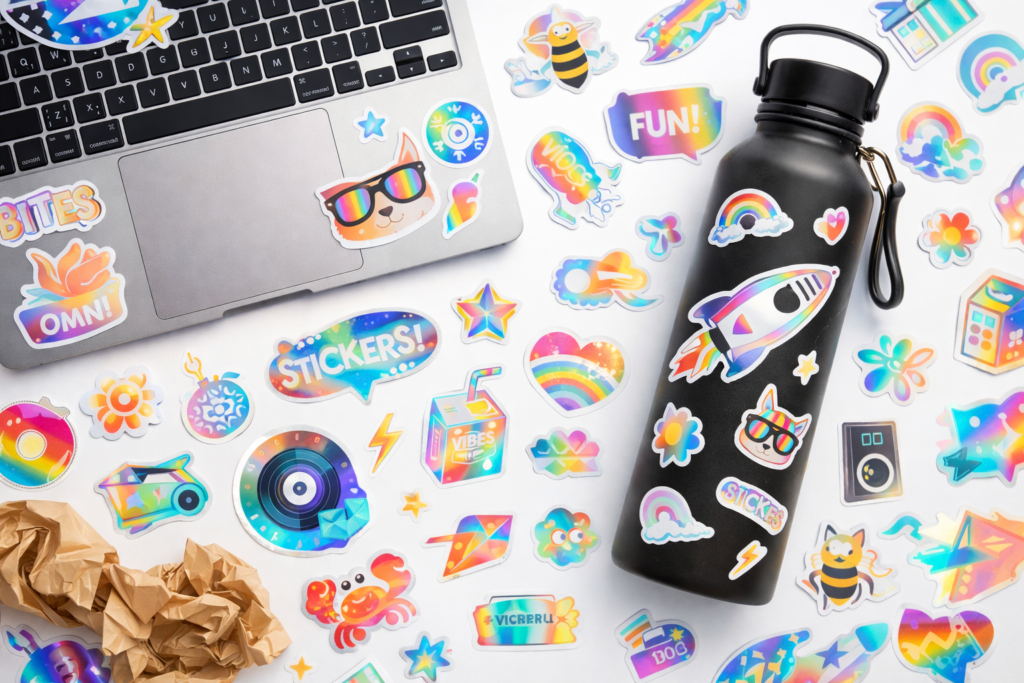
A sheet of 500 high-quality custom stickers often costs less than a single week of social media advertising. Yet the visibility can last for years.
In an era dominated by fleeting digital ads, rising pay-per-click costs, and algorithm fatigue, smart marketers are rediscovering a surprising truth: custom stickers remain the most effective, enduring, and emotionally resonant marketing tool available today. Far from being a nostalgic relic, the sticker industry is booming—the global stickers market was valued at $12.4 billion in 2024 and is projected to reach $18.9 billion by 2032, growing at a compound annual rate of 5.7%. The personalized stickers segment alone is set to surge from $4.58 billion in 2024 to approximately $7.99 billion by 2034.
This comprehensive guide explores why custom stickers have not only survived the digital revolution but have emerged as the undisputed champion of cost-effective, high-impact brand building.
The Undeniable Growth: Numbers Don’t Lie
The sticker industry’s trajectory tells a compelling story. According to UPrinting’s 2025 market analysis, 72% of businesses report that custom stickers are cost-effective for branding and customer engagement. Search interest mirrors this confidence—Google Trends data shows searches for “custom stickers” climbed 40% year over year, with “straw topper” rising 34% and “pins” increasing 13% in the past 12 months alone.
What’s driving this growth? Short-run jobs are on pace to account for 45–55% of all orders by 2026, reflecting the shift toward smaller, more targeted, and seasonal marketing campaigns. Digital printing has evolved from a mere proofing tool to the production backbone for these flexible, variable-data runs.
Why Stickers Outperform Digital Ads: The Cost-Effectiveness Factor
The economics of sticker marketing are nothing short of extraordinary. While digital advertising requires ongoing spend for every impression, a custom sticker generates passive, continuous exposure for a single upfront investment.
A sheet of 500 high-quality custom stickers is frequently cheaper than the cost of one week of social advertising across major platforms, yet the visibility can remain for years. A single sticker can cost far less than a penny per view over its lifetime, because the surface you place it on keeps moving through daily life—a water bottle sits in meetings, a laptop travels to coffee shops, a bumper sticker commutes through city streets.
The math is striking. One industry analysis concluded that stickers are literally 10,000x more cost-effective per impression than digital ads. Consider the compound effect: one sticker placed on a laptop gets seen in a coffee shop by 50 people. Someone asks about it. A conversation starts. A photo gets taken and posted online. Suddenly, that single sticker generates exponential exposure far beyond its original placement.
The Neuroscience of Stickers: Why Physical Marketing Works
Digital ads are built to be seen. But what people remember is often what they do. That’s why tactile marketing—stickers, labels, seals, and decals—holds such power over memory and brand recall.
Neuromarketing studies have shown that printed materials light up parts of the brain tied to emotion and memory. Surveys over the past two years also show higher trust in print than in online ads. Unlike a digital ad that disappears after a scroll, a physical sticker has “legs.” It moves through the real world, accumulating impressions long after its initial distribution.
When someone chooses to place a sticker on their personal belongings—their laptop, water bottle, car bumper, or phone case—they’re giving your brand a subtle endorsement. They’re saying, “This represents me”. This voluntary act of brand affiliation creates a psychological bond that no banner ad can replicate.
Building Loyalty That Lasts: The Retention Power of Stickers
The most successful brands understand that customer retention is more valuable than acquisition. Stickers are an underrated retention play. Brands like Glossier and Liquid Death built part of their loyal following through stickers—customers proudly stick them on their belongings, turning everyday objects into moving billboards for the brands they love.
Real-world results validate this strategy. One retail client saw a 40% increase in brand recognition after implementing custom stickers on their packaging. Another business integrating vibrant, durable stickers reflecting their brand identity achieved a 30% increase in customer engagement and a significant boost in brand recall. Direct-to-consumer sticker programs have been shown to improve repeat purchase rates by 0.4–0.9 percentage points when execution quality remains high.
The Psychology of Stickers: Why We Love Them
The human obsession with stickers runs deep. They satisfy fundamental psychological needs:
Self-expression: Stickers allow individuals to curate their identity, displaying affiliations, humor, values, and aesthetics on their personal belongings.
Accomplishment and tracking: Many people use stickers as motivation—ticking off tasks, tracking habits, or marking milestones in planners.
Community signaling: When loyal fans place your sticker on their car bumper or travel mug, they signal their affinity for your brand to others, growing awareness organically.
Stickers make a brand feel personal and relatable, seamlessly blending into consumers’ lifestyles. This emotional connection is precisely what digital advertising struggles to achieve.
Creative Ways to Use Custom Stickers in Your Marketing Mix
The versatility of stickers is unmatched. Here are proven applications:
Application
Impact
Packaging Inserts
Surprise and delight customers with every order
Trade Show Giveaways
Lightweight, portable, and highly memorable swag
Event Promotions
QR-coded stickers bridge offline and online engagement
Loyalty Rewards
Exclusive sticker designs for repeat customers
Product Seals
Add authenticity and premium feel to packaging
Influencer Collaborations
Co-branded stickers extend reach organically
Limited-Edition Drops
Create scarcity and collectible appeal
Employee Swag
Build internal brand pride and external visibility
Savvy brands use physical media to create connection in ways digital simply cannot match. Some of the world’s most creative marketing campaigns have used stickers to cut through the noise.
2026 Sticker Trends: What’s Hot Right Now
Sticker marketing is evolving with exciting new trends that savvy brands are already leveraging:
Interactive and AR-Ready Stickers: Designs that integrate with augmented reality, unlocking digital content when scanned
Eco-Friendly Materials: Sustainable, biodegradable, and recycled-content stickers are increasingly in demand
Holographic and Foil Finishes: Eye-catching metallic effects that demand attention
Nostalgia and Y2K Aesthetics: Vintage-inspired designs tapping into cultural memory
Character-Led Branding: Stickers featuring brand mascots or personalities that build emotional connection
Waterproof Durability: A clear upward trend, particularly from May to September, indicating growing consumer preference for long-lasting outdoor stickers
The sticker market in 2026 is characterized by a strong emphasis on personalization, sustainability, and digital integration. Brands that align with these trends will see higher engagement and stronger returns.
From Viral Crazes to Everyday Marketing: Stickers in Action
Real-world examples demonstrate the power of sticker marketing:
A beverage company launched what might be the smallest outdoor media campaign in one of the world’s busiest cities: strategic sticker placements on Broadway in New York City, right outside the iconic Nike Store. The targeted effort generated nearly three times more revenue per ad than general campaigns.
In Singapore, Gen Z illustrators have turned bedroom doodles into thriving businesses, with full-fledged merchandise and characters commanding loyal followings. In the Gulf, tiny pressed metal stickers barely three centimeters tall have become the region’s newest viral obsession—small enough to pinch between fingers, but loud enough to form a glinting portrait of personality.
These examples prove that whether you’re a global brand or a solo entrepreneur, stickers deliver results.
Why Partner with a Dedicated Sticker Manufacturer
The effectiveness of your sticker marketing campaign depends entirely on quality. A poorly printed sticker that peels, fades, or looks unprofessional will damage your brand rather than enhance it. That’s why choosing the right manufacturing partner is critical.
At Shenzhen Tengyue Gift Co., Ltd. , we specialize in producing premium custom stickers that elevate your brand. Our capabilities include:
Multiple material options: Premium vinyl for outdoor durability, paper for cost-effective indoor use, clear vinyl for “floating” designs, and holographic/foil finishes for maximum visual impact
Precision die-cutting: Custom shapes that perfectly match your logo or design
Vibrant color reproduction: UV printing, silk screen, and full-color digital options
Eco-friendly choices: Sustainable materials and processes for environmentally conscious brands
Low minimum quantities: Flexible ordering for campaigns of any scale
We understand that every sticker tells a story about your brand. Our commitment to quality ensures that your story is told beautifully, durably, and memorably.
Ready to make your brand stick? Visit “Custom Stickers” today to explore our custom sticker options and start creating marketing tools that truly last.
Frequently Asked Questions (FAQs)
1. Are custom stickers really cost-effective compared to digital ads? Absolutely. A single sticker can generate impressions for years at a fraction of the cost of ongoing digital campaigns. One industry analysis found stickers to be 10,000x more cost-effective per impression than digital ads.
2. What types of stickers work best for outdoor marketing? Premium vinyl stickers with UV-resistant lamination are ideal for outdoor use. They’re waterproof, weatherproof, and designed to last for years on surfaces like cars, water bottles, laptops, and outdoor equipment.
3. Can I use stickers to drive online engagement? Yes. QR-coded stickers or those with unique URLs bridge offline and online marketing perfectly. A sticker placed on packaging can direct customers to a landing page, loyalty program sign-up, or social media contest.
4. What are the most popular sticker trends for 2026? The hottest trends include interactive/AR-ready designs, eco-friendly materials, holographic finishes, nostalgic Y2K aesthetics, character-led branding, and waterproof durability.
5. How many stickers should I order for a campaign? It depends on your goals. For small events or test runs, 250–500 stickers may suffice. For broader brand awareness campaigns, 1,000–5,000 units offer better per-unit economics. Many manufacturers, including Tengyue Gift, offer low minimum order quantities to accommodate campaigns of any size.
6. How do I design an effective sticker for brand awareness? Focus on clean, legible branding at a glance. Use your logo prominently, choose colors that stand out, and consider the surface where the sticker will be placed. Keep text minimal—your brand name and perhaps a tagline or website URL.
7. Can stickers really help with customer retention? Yes. Brands like Glossier and Liquid Death built significant loyalty through sticker programs. Studies show that physical brand touchpoints like packaging inserts and stickers can boost retention and customer lifetime value significantly.
8. What’s the difference between die-cut and kiss-cut stickers? Die-cut stickers are cut precisely to the shape of your design, creating a custom outline. Kiss-cut stickers are cut through the vinyl layer but not the backing paper, leaving multiple stickers on a single easy-to-store sheet—ideal for giveaways and retail sales.
9. Are eco-friendly stickers as durable as conventional ones? Yes. Modern eco-friendly stickers made from recycled or biodegradable materials can match the durability of conventional options. Look for manufacturers offering sustainable materials without compromising on waterproofing or UV resistance.
10. How long does it take to produce custom stickers? Typical turnaround ranges from 3–10 business days depending on quantity, complexity, and shipping options. Rush production is often available for urgent campaigns.
Conclusion
In a marketing landscape increasingly dominated by fleeting digital impressions, rising ad costs, and algorithm fatigue, custom stickers stand as a beacon of efficiency, authenticity, and enduring impact. They are small, affordable, and ridiculously sticky—in more ways than one. Brands using custom stickers aren’t just making merchandise; they’re planting flags in the wild, creating real-world touchpoints that digital advertising can never replicate.
The data is clear: the sticker industry is growing, consumer demand is surging, and businesses of all sizes are discovering that this humble marketing tool delivers extraordinary returns. Whether you’re looking to boost brand awareness, drive customer loyalty, or create viral moments, custom stickers belong at the center of your marketing strategy.