
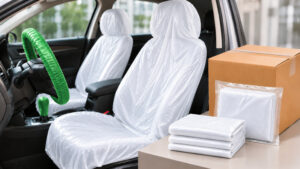
In the automobile sector, vehicle maintenance, cleanliness, and protection of the interiors are important for dealerships, repair workshops, car rental companies and services. OEM disposable car seat covers offer a practical solution by keeping seats free from dust, grease, moisture, and everyday contaminants during servicing, transportation and vehicle delivery. For businesses sourcing these products, selecting the right materials, packaging, and branding options is important to balance quality, cost and brand recognition.
Working with a reliable OEM seat cover manufacturer allows businesses to customise disposable seat covers based on their operational requirements and marketing objectives.
1. Choosing the Right Materials
Material seletion of directly affected to thew durability, comfort, protection and costs. Businesses will consider the inteneded to the application before selecting a suitable materials for the disposable automotive seat covers.
- Polyethene (PE): PE is one of the popular options since it offers moisture resistance and helps to protect seats against grease, dirt, and liquid splashes. It is the lightweight structure do makes it a suitable for vehicle maintenance, dealing, and dealership applications.
- Nonwoven polypropylene (PP): PP provides a softer texture with a fabric-like appearance, matching traditional plastic covers. It is suitable for businesses that are looking for a more professional presentation and improved handling when the installation is done.
- Composite materials: Many applaications are benefitted froma laminated or multilayer materials which combines with different protective properties. All of these options will help to improve resistance to moisture and tearing. These trust the material construction.
When there is an evaluation of OEM disposable car seat covers, buyers will compare thickness, tensile strength, coverage, fit, and ease of disposal. Material specifications will also match the intended usage, applicable regulations, and target market. For businesses that give priority to sustainability, recyclable materials, and reduction of packaging waste, these are worth discussing with the suppliers.
2. Packaging Considerations for OEM Orders
Packaging plays a vital role in product protection, storage, transportation, and inventory management. Since disposable seat covers are often ordered in bulk, practical packaging will improve warehouse efficiency and simplify distribution.
Individual packaging will be right for premium service environments, organised for vehicle preparations or retail distribution. Bulk packaging, on the other hand, will reduce handling requirements and might lower packaging costs for workshops and high-volume service centres.
The experienced OEM seat cover manufacturer will offer different packaging configurations based on order quantities and customer needs. Options will include transparent bags, printed polybags, cartons, and customised labels.
Buyers must confirm the number of covers per pack, carton dimensions, product identification details, and shipping requirements before production begins. Packaging will protect the covers from dust and moisture during storage and transportation without adding unnecessary materials.
For international orders, businesses will also verify packaging and labelling requirements in destination markets. A clear specification does help minimise misunderstandings, which will improve stock control and create a consistent purchasing experience.
3. Branding and Private-Label Opportunities
Branding does help automotive businesses to create a consistent professional image across their service operations. Branded disposable seat covers will display a company logo, brand colours, slogan, or other approved visual elements.
For dealerships, service networks, and automotive distributors, customised seat covers will reinforce brand visibility whenever vehicles enter a workshop or go through an inspection. Even a simple printed logo will make routine vehicle protection products look more professional.
All of these products also represent a chance for their private-label automotive products. These allow distributors and wholesalers to market customised items under their own brands rather than selling generic alternatives.
Before approving a design, buyers will review logo placement, print clarity, colour consistency, and artwork compatibility with selected materials. They will also request a sample or digital proof before mass production is processed.
Businesses that are sourcing from Shenzhen Tengyue Gift Co., Ltd. will discuss their OEM customisation requirements, which are going to include product specifications, packaging preferences and branding concepts for the determination of their target customers.
4. Selecting a Reliable OEM Supplier
Selection of the right supplier requires more than comparing unit prices. Buyers will evaluate material consistency, production capacity, customisation capability, quality-control processes, communication, and delivery schedules.
Ask potential suppliers about minimum order quantities, sampling arrangements, production lead times, packaging options, and available quality documentation. Confirmation of these details early helps businesses plan procurements more effectively.
It is also essential to create acceptance of the measure for dimensions, material thickness, printing quality, and packaging before approving a bulk order. Well-defined specifications reduce the risks of inconsistent products and unexpected costs.
Conclusion
Selection of a suitable OEM disposable car seat cover requires balancing material performance, practical packaging, and effective branding. The right combination will help automotive businesses protect vehicle interiors, streamline daily operations, and strengthen brand recognition. By working with a dependable OEM seat cover manufacturer and carefully evaluating customisation options, companies will develop branded disposable seat covers which will support their wider private-label automotive product strategy. Businesses like Shenzhen Tengyue Gift Co., Ltd. should discuss their specific requirements and confirm product capabilities, samples, pricing and production timelines before placing the order.
FAQs
- What materials are commonly used for OEM disposable car seat covers?
Some of the common materials for OEM disposable seat covers are polyethene, nonwoven polypropylene, and certain composite materials. It depends on what kind of performance you want to achieve using these products. Also, it depends on your budget and the specific use case scenario.
- Can I customise a car seat cover with a company logo?
It is possible to customise the disposable car seat covers with a company logo, colour options, and brand-specific packaging. However, it will depend on the specific manufacturer, materials, printing method, and order size.
- What are the options for private-label packaging?
The most common private label packaging options for automotive products are individual bags, bulk packs, printed polybags with brand labels, customised packaging, and shipping cartons. It will depend on your specific logistics and distribution needs.
- How can businesses choose the right OEM seat cover manufacturer?
You should look at the material options, customisation, MOQ, sample policy, quality control, communication, and delivery timelines. Always double-check every detail and approve samples before you place an order for full production.