
Eco-sustainability has become a vital consideration for parents, educators, retailers and businesses while selecting products for children. Traditional books are commonly made from paper, cardboard, plastic coating, adhesives and ink. However, tin books are becoming an interesting alternative because of their durability, reusable design, and attractive appearance.
A tin book is usually a book-shaped metal container or interactive learning product designed to hold cards, puzzles, magnets, stationery, toys, or educational materials. All of these products are mainly used as gifts for children, promotional items, learning kits, and collectable packaging. However, the question remains whether tin books are eco-friendly. The answer depends on their materials, manufacturing process, lifespan, and disposal methods.
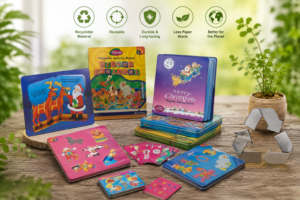
What Makes Tin Books Potentially Eco-Friendly?
One of the main environmental benefits of tin books is their durability. Paper books, cardboard boxes, and lightweight plastic packaging will become damaged after repeated use. Tin books are stronger and will withstand regular handling, transportation, and storage.
Well-designed tin books for children will be reused for many years. After children finish using the original learning materials, the tin book will store pencils, flashcards, stickers, small toys, craft supplies, photographs, or personal items. Its extended lifespan reduces the need for disposable storage boxes and packaging.
Tinplate and steel are also widely recyclable materials. When the tin book reaches the end of its usable life, it might be recycled through the appropriate metal recycling systems. However, customers will remove non-metal components like plastic inserts, foam, magnets, or paper accessories whenever possible before recycling.
Reusability Is an Important Advantage
The environmental impact of a product might not be measured only by the material used to manufacture it. Its life is equally important. The reusable tin book will also offer better long-term value than packaging which is used once and immediately discarded.
For example, companies purchasing wholesale tin books will create educational kits or gift products which customers are encouraged to keep. The high-quality tin book will become part of the product experience rather than being treated as ordinary packaging.
Businesses will also print useful designs on the tin surface like alphabets, numbers, maps, puzzles, drawing activities, or educational illustrations. These will make the container functional even after the original products inside have been removed.
Are All Tin Books Sustainable?
No, not every tin book is automatically eco-friendly. Sustainability depends on responsible product design and manufacturing.
Manufacturers will minimize unnecessary plastic parts, excessive packaging, and difficult-to-separate materials. Water-based or lower-impact printing solutions will also be considered where technically suitable. The product will be manufactured with smooth edges, safe coatings, secure closures, and durable construction, which are intended for children.
Working with the experienced OEM tin book manufacturer will allow brands to control the material thickness, dimensions, internal accessories, printing, packaging, and overall product quality. Better-quality production will increase the lifespan of the product and reduce the possibility of early damage or disposal.
Companies should also avoid making broad environmental claims without evidence. Instead of simply describing a product as “100% eco-friendly,” brands will highlight specific features like recyclability, reusability, durability, reduced plastic content, or long-term storage value.
Tin Books as Promotional Gifts
Tin books might also be used by schools, publishers, toy companies, event organizers, and corporate brands. The reliable promotional gift manufacturer may customize the tin book with company logos, educational themes, character artwork, campaign messages, or branded activities.
Unlike disposable flyers or lightweight promotional packaging, a useful tin book is more likely to remain with the recipients. This provides longer brand exposure, which will reduce dependence on single-use promotional materials. However, businesses will keep the design practical. Adding excessive decorative layers, plastic windows, foam inserts, or mixed-material accessories might make the product more difficult to recycle. A simple, durable, and reusable design is usually a more responsible choice.
How Will Brands Make Tin Books More Sustainable?
Brands will improve the environmental performance of tin books by focusing on thoughtful design. The product will use only the amount of metal required for strength and safety. The internal trays and accessories will be reusable, recyclable, or easy to separate.
Packaging needs to be kept minimal. Manufacturers use recyclable paper cartons, avoid unnecessary plastic wrapping, and select compact packaging which will reduce transportation space. Ordering the correct quantity is equally important. Even though wholesale tin books will reduce production costs, businesses need to estimate demand carefully to avoid stock and material waste.
Final Thoughts
Tin books are a more sustainable option when they are durable, reusable, responsibly manufactured, and properly recycled. The long lifespan and storage value make them especially suitable for educational kits for children, promotional gifts, and collectable products.
Despite them sustainability depends on the complete product lifecycle. Brands will work with responsible manufacturers, minimize mixed materials, reduce unnecessary packaging, and communicate environmental benefits honestly. The carefully designed tin book will provide lasting educational and promotional value that will support more responsible consumption.
FAQs
Are tin books recycled?
Tin books are primarily from tinplate or steel and will be recyclable through local metal recycling facilities. Plastic, paper, foam, and magnet components need to be separated wherever possible.
Are tin books safer than plastic books for children?
Safety depends on the product quality rather than the materials alone. Tin books for children will have rounded edges, secure closures, non-toxic coating, and age-appropriate accessories.
Can tin books be reused after the original contents are removed?
Yes, they might be reused for storing stationery, flashcards, puzzles, toys, photographs, art materials, and other small objects.
What brand checks need to be made for selecting a tin book supplier?
Brands must review material quality, safety standards, printing capabilities, customisation options, packaging methods, quality control production capacity, and recycling considerations.