
A single die can exert over 700 tons of force to create a 1,000-piece puzzle in one press.
Have you ever paused, a uniquely shaped puzzle piece in hand, and wondered how this satisfying object was made? The journey from a beautiful image to a box of interlocking pieces is a fascinating blend of artistic vision, chemical engineering, and mechanical precision. For over 260 years, since cartographer John Spilsbury first glued a map to wood and sawed it apart, the core concept has remained delightfully simple. Today, modern jigsaw puzzle manufacturing is a sophisticated process that ensures every piece fits perfectly, creating endless hours of focused enjoyment. This article pulls back the curtain to reveal the meticulous steps, advanced technology, and stringent quality control that go into crafting your favorite puzzles.
Phase 1: The Creative Foundation – Artwork and Design
Every great puzzle starts with an engaging image. Manufacturers often work with artists to commission bright, detailed, and colorful artwork specifically designed to entertain and challenge the puzzler. This image is then meticulously prepared. It is scanned and refined using photo-editing software to ensure colors are vibrant and details are crisp for the printing process.
Simultaneously, one of the most crucial behind-the-scenes steps occurs: designing the cut pattern. Using Computer-Aided Design (CAD) software, engineers map out the unique shape of every single piece. A key goal is to ensure no two pieces are identical, preventing false fits and guaranteeing each piece has only one correct place. This digital design will ultimately guide the physical cutting tools.
Phase 2: Precision Engineering – Crafting the Cutting Die
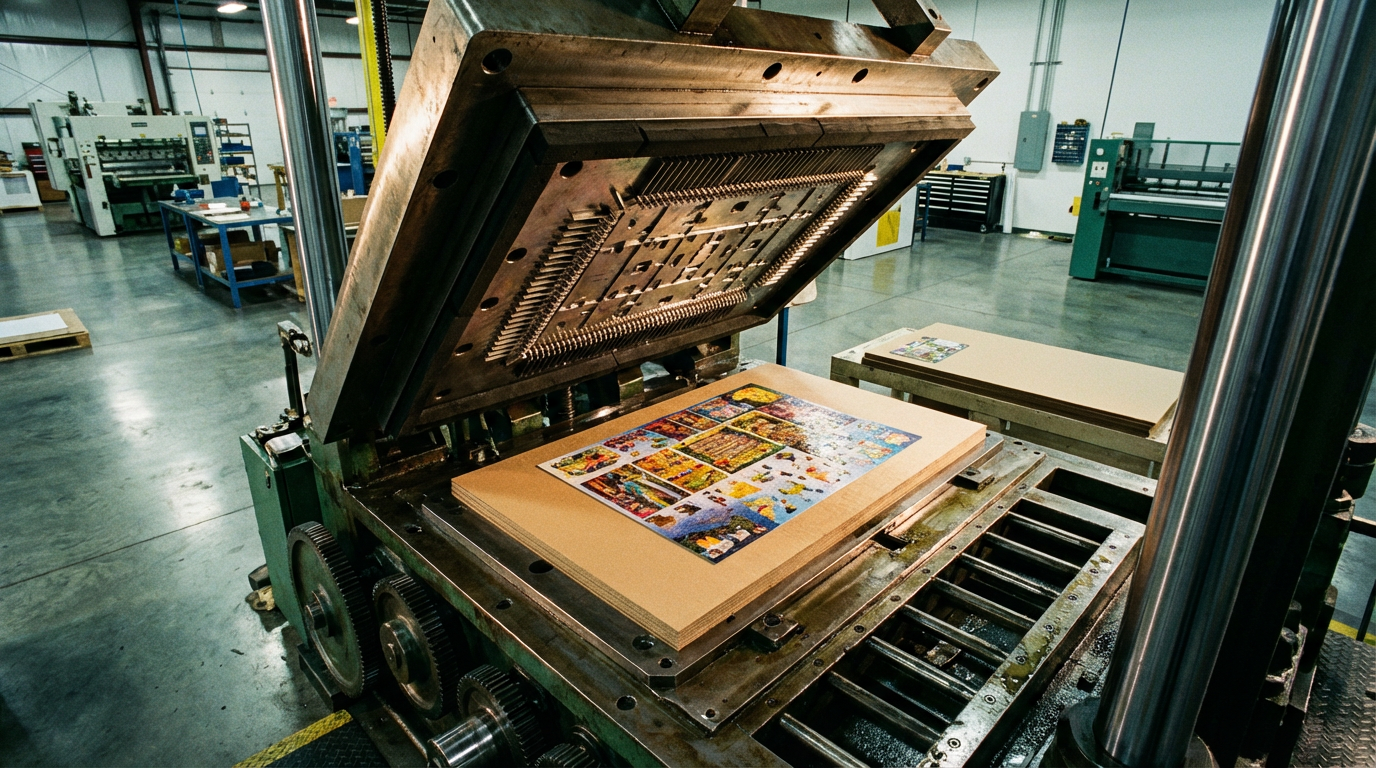
The heart of the manufacturing process is the cutting die—a massive, precision tool akin to a highly complex cookie cutter. For traditional die-cutting, craftsmen painstakingly bend and set hardened steel blades into a plywood board, following the CAD pattern. This can be an intricate, week-long process involving laser-cutting, hand-finishing, and grinding the blades to sharp points.
These blades are then embedded in a compressible rubber material, which later helps eject the cut puzzle pieces. Once assembled, this die is mounted into a hydraulic die-cutting press. The forces involved are immense, with a typical press generating over 700 tons of force to cleanly punch through thick puzzle board.
Phase 3: Production – Printing, Mounting, and the Big Cut
With the artwork and die ready, physical production begins in earnest.
- Printing: The approved image is printed onto high-quality paper, typically using the lithographic process. This method uses oil-based inks on treated plates to produce sharp, color-accurate results efficiently. Modern manufacturers often use vegetable-based, quick-drying inks for a more sustainable and safer product.
- Mounting and Lamination: The printed sheet is then bonded to a stiff backing board, usually high-quality cardboard. This is a critical step where the right adhesive is essential. Manufacturers choose glues that dry clear and quickly without warping the board or bleeding through the paper. The laminated board must then cure for several days to ensure a perfectly flat, stable canvas.
- The Die-Cutting Moment: The cured board is fed into the die-cutting press. In one thunderous “click,” the massive die descends, punching the entire intricate network of pieces at once. What emerges is a complete puzzle image, still held together by tiny nibs (the connecting cardboard), but now discretely cut into hundreds of individual shapes.
Phase 4: Finishing – Separation, Quality Control, and Packaging
- Separation and Scrambling: The cut puzzle panel travels to a scrambling machine, where rotating blades gently but thoroughly break the pieces apart and mix them up. The pieces are then channeled into a bag.
- Rigorous Quality Control: Before packaging, quality checks are paramount. Manufacturers inspect sample pieces for clean cuts, ensure the image is firmly adhered, and verify the count. Some use camera systems to check that every piece from the die is present.
- Sustainable Packaging: The bag of pieces is placed into a sturdy box featuring the finished puzzle image on its lid. Leading manufacturers are now adopting eco-friendly practices, using recycled cardboard for boxes and boards, and replacing plastic shrink-wrap with biodegradable seals.
The Role of Advanced Cutting Technologies
While die-cutting is the standard for mass production, advanced technologies enable special puzzles:
- Laser Cutting: Uses high-powered lasers for extreme precision, allowing for intricate, custom piece shapes and smoother edges, often used for premium wooden or acrylic puzzles.
- Water Jet Cutting: Employs a high-pressure stream of water and abrasive to cut through materials like metal or thick wood without heat damage.
The Tengyue Gift Commitment to Quality Manufacturing
At Tengyue Gift, we are more than just a retailer; we are passionate manufacturers who understand and control every step of this intricate process. We believe the quality of your puzzling experience is determined long before you open the box.
Our commitment is to manufacturing excellence:
- Artistic Collaboration: We source and create vibrant, engaging artwork designed to captivate and challenge.
- Precision Engineering: We invest in precision-cut dies and modern press technology to ensure each piece has a clean, exact fit and a satisfying snap.
- Material Integrity: We select superior, durable board and use specialized adhesives to prevent warping and ensure the printed image lasts.
- Sustainable Focus: We actively explore eco-friendly materials and processes to minimize our environmental footprint.
We invite you to experience the tangible difference that manufacturer-direct quality makes. Explore our diverse collections at https://www.tengyuegift.com/ and discover a puzzle crafted with care, from the first sketch to the final piece in the box.
Frequently Asked Questions
1. What are jigsaw puzzles made of?
Most modern puzzles are made from a printed paper layer laminated onto a thick cardboard backing (called chipboard or paperboard). Premium puzzles can be made from wood, plastic, or even metal.
2. How is the unique shape of each piece created?
A custom-made cutting die—a large board filled with shaped steel blades—is pressed into the puzzle board with immense force, cutting all pieces simultaneously. The pattern is designed using computer software to ensure every piece is unique.
3. Can puzzles be made from a personal photo?
Yes. Many manufacturers offer custom puzzle services. Your photo is digitally prepared, printed, and cut using the same standard die-cutting or laser-cutting processes.
4. Why do some puzzle pieces fit loosely or seem to bend?
This can result from lower-quality cardboard, adhesive that causes warping, or a dull cutting die that doesn’t create crisp edges. High-quality manufacturing uses sturdy board, warp-free glue, and sharp dies for a perfect snap-fit.
5. What does “die-cut” mean?
It refers to the primary manufacturing method where a steel die (a shaped blade) is used to cut the material. It’s a stamping process, not a sawing process.
6. Are there environmentally friendly puzzles?
Absolutely. Many manufacturers now use recycled cardboard, soy-based inks, and minimal or biodegradable packaging, moving away from plastic shrink-wrap.
7. How long does it take to manufacture a puzzle?
While the actual printing and cutting are fast in mass production, the entire process—from design and die creation to adhesive drying and quality checks—can take several weeks from concept to finished box.
Conclusion
The manufacturing of a jigsaw puzzle is a remarkable synthesis of creativity and engineering. From the initial artist’s brushstroke to the final thunderous press of the cutting die, each step is calibrated to produce an object of simple, profound pleasure. Understanding this process deepens our appreciation for the humble puzzle piece—it is not just cardboard, but a product of design, chemistry, and immense mechanical force. The next time you fit a piece perfectly into place, you’re not just solving a puzzle; you’re engaging with a centuries-old craft perfected by modern manufacturing artistry.